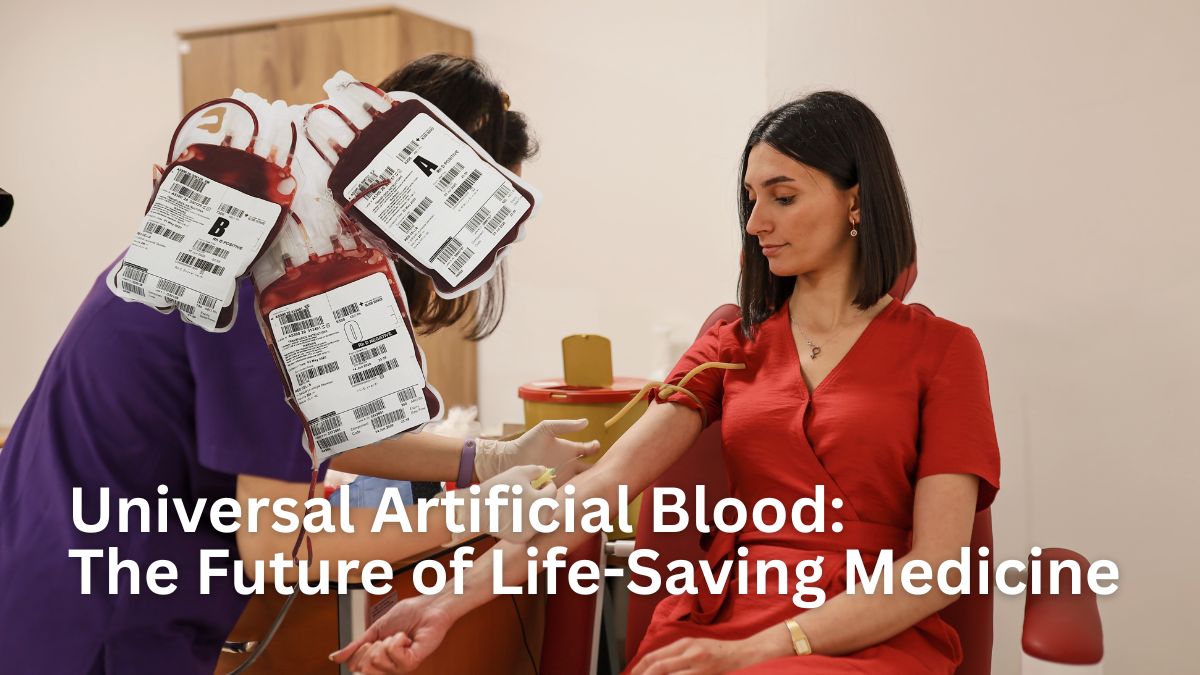
Every second, somewhere in the world, a life hangs in the balance, waiting for a thin plastic tube and a bag of crimson liquid. Whether it is a victim of a high-speed traffic accident, a patient undergoing complex cardiac surgery, or a mother facing sudden complications during childbirth, blood is the ultimate currency of survival.
However, we are currently facing a silent global crisis: we are simply running out of it. The quest for Universal Artificial Blood is no longer just a plot point in a sci-fi novel; it has become a necessity of modern bioengineering. In this deep dive, we will explore why synthetic substitutes are set to revolutionize healthcare, the science behind “universal” compatibility, and how close we are to a world where blood shortages are a thing of the past.
1. The Bottleneck: Why Natural Blood Isn’t Enough
To understand the desperate need for artificial blood, we must first look at the massive logistical and biological limitations of the “real thing.” Human blood is a biological miracle, but for modern medicine, it is a logistical nightmare.
The Perishability Problem
Natural blood is a living tissue, and like all living things, it dies. Red blood cells have a shelf life of approximately 42 days, while platelets—the cells that help blood clot—expire in just 5 days. This creates a constant “treadmill” for blood banks; they can never stop collecting because their inventory is constantly expiring.
The Complexity of Blood Typing
You cannot simply give any blood to any person. If a doctor transfuses Type A blood into a Type B patient, the immune system views it as a hostile invader, leading to a potentially fatal hemolytic reaction. While Type O-Negative is the “universal donor,” it is also the rarest and most in-demand, often leaving emergency rooms in short supply during mass-casualty events.
The Logistics of War and Remote Areas
In a combat zone or a remote village, keeping blood refrigerated at exactly 2°C to 6°C is nearly impossible. Many lives are lost simply because the blood “spoiled” before it could reach the patient. This “cold chain” requirement is the single biggest barrier to saving lives in the developing world.
2. What Exactly is Universal Artificial Blood?
When we talk about “Artificial Blood,” we aren’t necessarily looking for a red liquid that replicates every single function of human blood. Human blood is incredibly complex, containing white blood cells for immunity and plasma for nutrient transport.
Instead, synthetic blood—technically known as Oxygen Therapeutics—focuses on the most critical job: Oxygen Transport.
The goal is to create a “bridge” or a “stop-gap” that keeps the patient’s organs alive and oxygenated until their body can regenerate its own cells or until they can be transported to a hospital for a full, natural transfusion.
3. The Three Scientific Frontiers of Synthetic Blood
Scientists are currently attacking this problem from three distinct angles, each with its own set of advantages and hurdles.
A. Hemoglobin-Based Oxygen Carriers (HBOCs)
These are created by extracting hemoglobin—the protein that carries oxygen—from real red blood cells (often sourced from outdated human blood or even bovine sources).
The Advantage: They do not have the protein “coatings” on the cell surface that determine blood type, making them truly universal.
The Challenge: In early trials, “naked” hemoglobin caused blood vessels to constrict, leading to high blood pressure. Modern researchers are now “wrapping” or polymerizing the hemoglobin to prevent these side effects.
B. Perfluorocarbons (PFCs)
PFCs are entirely synthetic, chemically inert liquids that can dissolve massive amounts of oxygen—far more than natural blood can.
The Advantage: Because they are 100% synthetic, there is zero risk of transmitting human diseases like HIV or Hepatitis. They can also be produced in massive quantities in a factory.
The Challenge: They do not mix well with water or blood, so they must be turned into an emulsion (similar to how fat is suspended in milk) before they can be injected.
C. Stem-Cell Derived Blood (Lab-Grown)
This is the “Holy Grail.” Instead of making a chemical substitute, scientists grow real, human red blood cells in a laboratory using stem cells.
The Progress: Recent clinical trials, such as the RESTORE trial in the UK, have successfully transfused lab-grown cells into human volunteers.
The Barrier: Scalability. Currently, growing enough blood for one person in a lab costs thousands of dollars and takes weeks. We are still years away from “blood factories.”
4. Comparison: Natural vs. Artificial Blood
Feature
Donated Human Blood
Universal Artificial Blood
Compatibility
Must match (A, B, AB, O)
100% Universal
Storage
Strict Refrigeration
Often Shelf-Stable (Room Temp)
Shelf Life
42 Days
1–2 Years
Disease Risk
Rare, but possible
Effectively Zero
Production
Dependent on volunteers
Scalable in factories
5. The “Universal” Breakthrough: Ending the Type Barrier
One of the most exciting recent developments isn’t actually “synthetic” blood, but the use of enzymes to “strip” the antigens off of donated blood.
Think of blood types like different “locks.” Type A blood has “A-locks” on its surface. If we use specialized enzymes (often derived from gut bacteria) to “eat” those locks, the blood becomes Type O—the universal donor. This technology could allow blood banks to convert their entire inventory into universal blood, effectively ending the shortage of O-Negative blood overnight.
6. Impact: From the Battlefield to the Emergency Room
The implications of this technology are staggering.
Military Medicine: Medics could carry powdered artificial blood in their kits, mixing it with sterile water on the front lines to save soldiers who would otherwise bleed out.
Rural Healthcare: Small clinics in remote areas that cannot afford expensive blood-refrigeration systems could stock artificial blood on their shelves for years, ready for any emergency.
Organ Transplants: Artificial blood could be used to keep organs “alive” and oxygenated for much longer during transport, increasing the success rate of transplants.
7. What is Holding Us Back?
If the technology is so promising, why isn’t it in every ambulance today? There are three main “bosses” that scientists still need to defeat:
Short Circulation Time: While natural red blood cells live for 120 days, most artificial versions only stay in the body for 24 to 48 hours.
Oxidative Stress: Hemoglobin outside of a cell can sometimes release “free radicals,” which can damage tissues if not properly managed.
Cost: Until we can move from lab-scale production to industrial-scale manufacturing, the price per unit remains too high for widespread use in developing nations.
8. Conclusion: A New Era of Healthcare
We are standing on the precipice of a medical revolution. Within the next decade, the fear of “not having the right blood type” may vanish. Universal Artificial Blood represents the perfect marriage of biology and engineering.
While it will not replace the need for human donors—who provide the complex immune cells and platelets synthetic versions lack—it will act as a vital safety net. It ensures that no one, regardless of their location or blood type, has to die simply because the right bag of blood wasn’t available at the right time.
The future of medicine isn’t just about curing diseases; it’s about re-engineering the very fluids that keep us alive.
![habitable_solution logo 2024 [t-w]](https://habitablesolution.com/wp-content/uploads/2025/02/habitable_solution-logo-2024-t-w.png)